Prices, Electricity, Industry and Post-Election Policy: Texas vs. Phoenix—Which Would You Choose?
Texas and Phoenix are often compared. This article lines up public data for both: prices, residential power rates, chip funding, data center tax breaks, and each state's measures, governors' direction and key dates after the 2026-11-03 election.

Article contents8 sections
Texas and Phoenix are both often seen as places in the U.S. where prices aren't as high and high-tech industries are growing. If you're choosing between the two, this article lines up public data for both side by side, using the same set of categories: prices, residential electricity rates, the semiconductor and data center industries, and what each state has been doing since the 2026-11-03 midterm election.
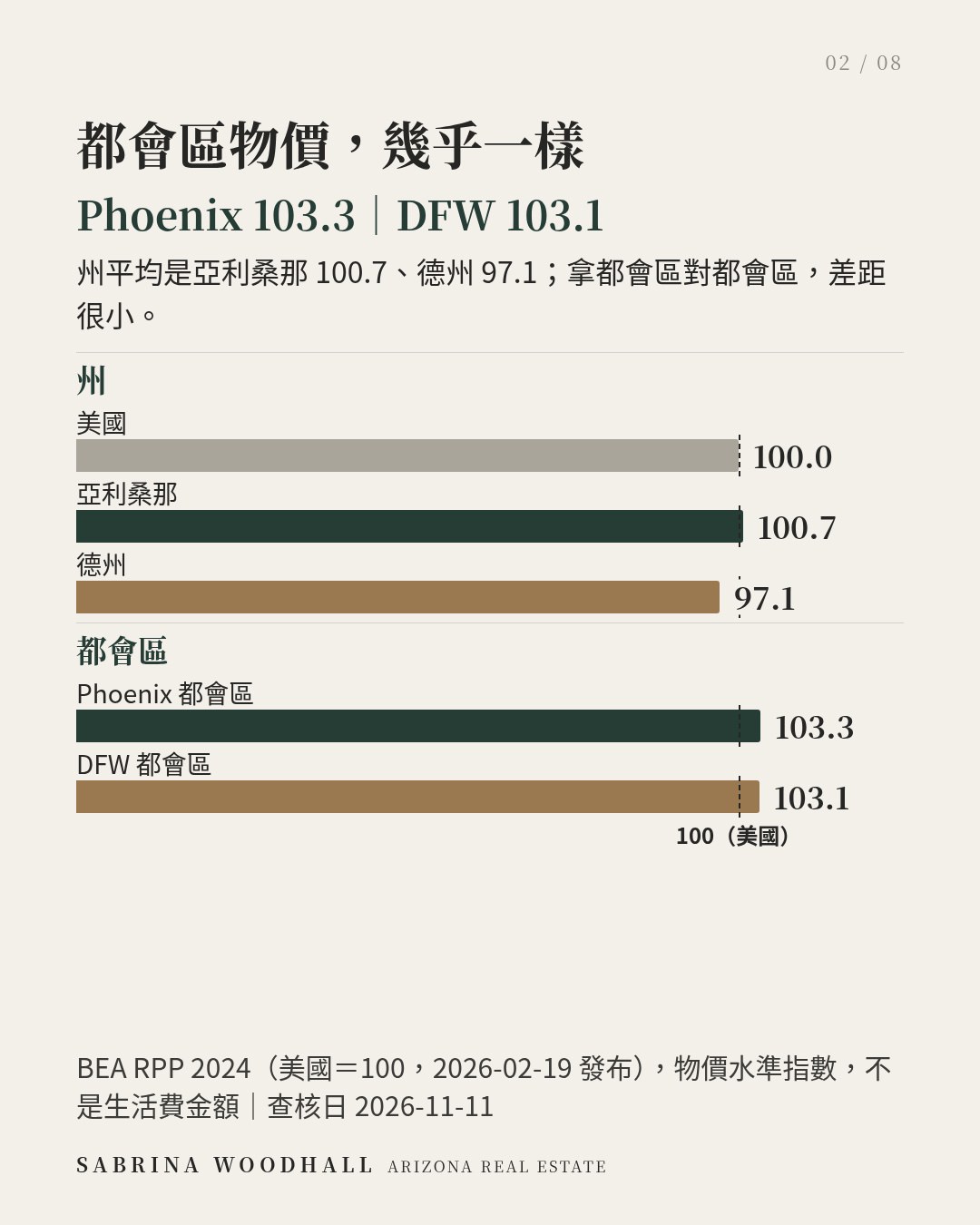
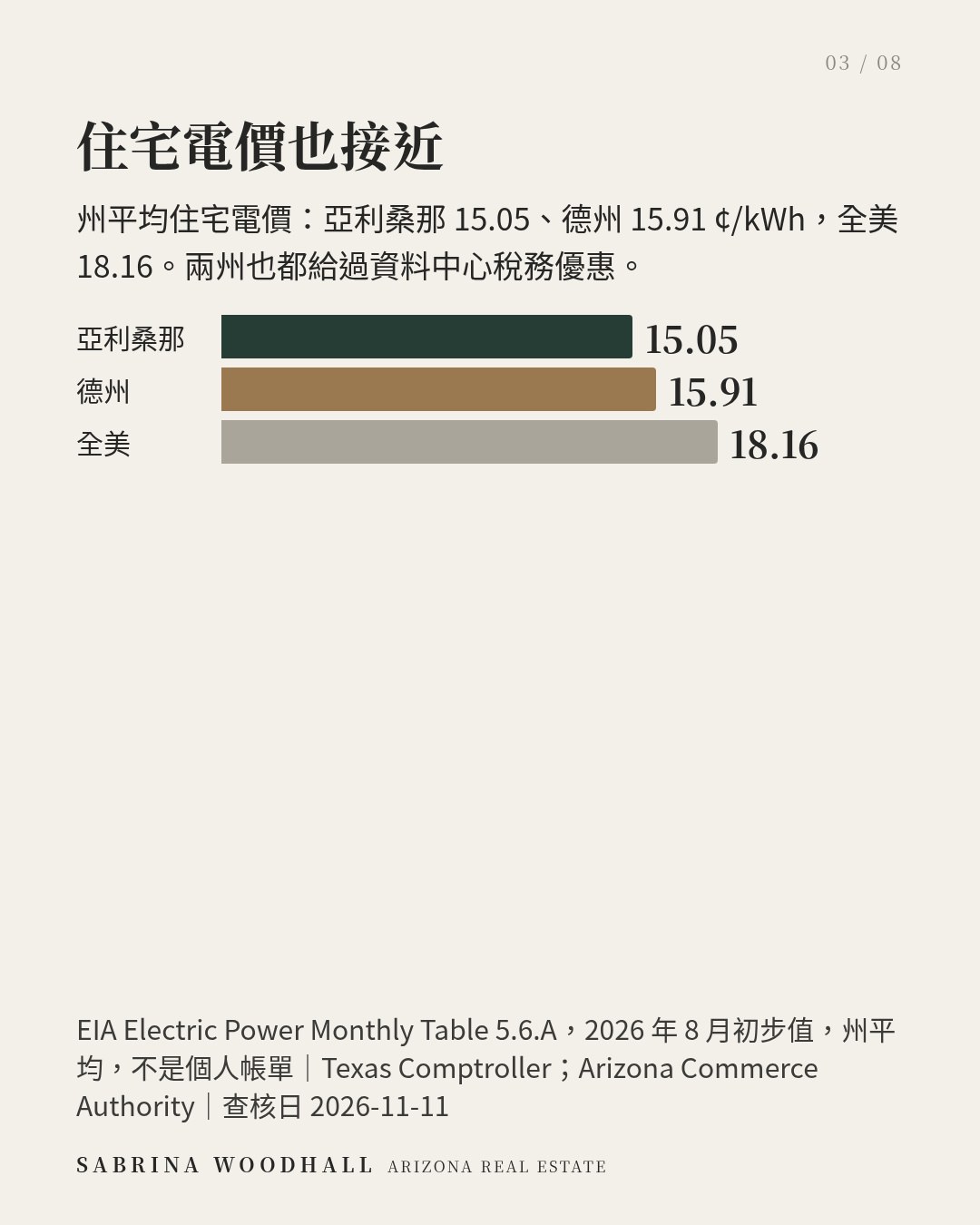
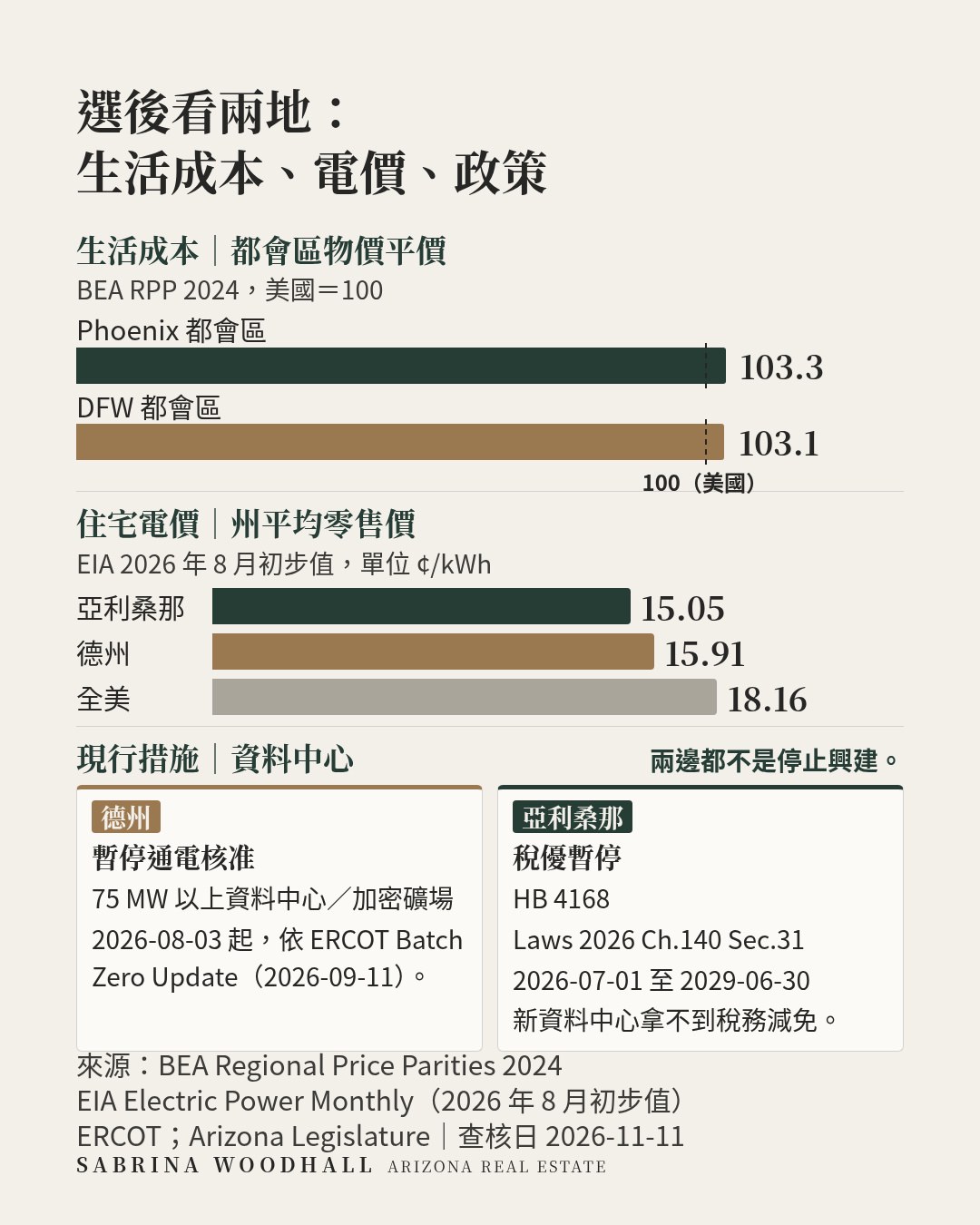
In BEA's Regional Price Parities (RPP) for 2024 (U.S. = 100), the Texas state average is 97.1 and the Dallas–Fort Worth metro area is 103.1; the Arizona state average is 100.7 and the Phoenix-Mesa-Chandler metro area is 103.3. In EIA's preliminary August 2026 data, the average residential electricity rate is 15.91 ¢/kWh in Texas and 15.05 ¢/kWh in Arizona, versus a U.S. average of 18.16 ¢/kWh. On the semiconductor side, both states have chip fabs or packaging plants that received direct CHIPS funding from the U.S. Department of Commerce, and both states offer tax incentives for data centers.
Prices: BEA Regional Price Parities (RPP)
- Texas: State average 97.1; Dallas–Fort Worth metro area 103.1.
- Arizona: State average 100.7; Phoenix-Mesa-Chandler metro area 103.3.
RPP is an index of price levels, not a dollar amount for the cost of living. (BEA RPP 2024, released 2026-02-19 | checked 2026-11-11)
Residential Electricity Rates: EIA State Averages
- Texas: 15.91 ¢/kWh.
- Arizona: 15.05 ¢/kWh.
The U.S. average is 18.16 ¢/kWh. These are state averages—not any individual household's bill, and not the rate data centers pay. (EIA Electric Power Monthly Table 5.6.A, preliminary August 2026 data | checked 2026-11-11)
Industry: Semiconductor Funding and Data Center Tax Incentives
Semiconductors: U.S. Department of Commerce CHIPS direct funding (final awards)
- Texas: Samsung, Taylor (including expansion of its existing Austin facility), $4.745 billion, announced 2024-12-20; Texas Instruments, two fabs in Sherman, $900 million (TI's total final award is up to $1.61 billion, including its Utah fab), announced 2024-12-20. (U.S. Department of Commerce; NIST CHIPS project pages | checked 2026-11-13)
- Arizona: TSMC Arizona, Phoenix, $6.6 billion, announced 2024-11-15; Amkor Technology, advanced packaging and test facility in Peoria, up to $407 million, announced 2024-12-20. (U.S. Department of Commerce; NIST CHIPS project pages | checked 2026-11-13)
These awards are disbursed in installments based on project milestones.
Data center tax incentives
- Texas: Qualifying data centers can receive a temporary exemption from the 6.25% state sales/use tax; local sales taxes still apply. (Texas Comptroller | checked 2026-11-11)
- Arizona: When the incentive applies, the Computer Data Center Program exempts all three layers of sales tax—state, county and local; new applications have been suspended since 2026-07-01 (see the next section). (Arizona Commerce Authority | checked 2026-11-11)
The two states' data center incentives are designed differently, so you can't directly conclude which state taxes data centers less.
What Each Place Has Been Doing Lately
Following the 2026-11-03 midterm election, unofficial results are in for both states' governor races. Below, each state is covered in the same order: election results, measures already in effect, what's still promised or under discussion, and the governor's post-election remarks.
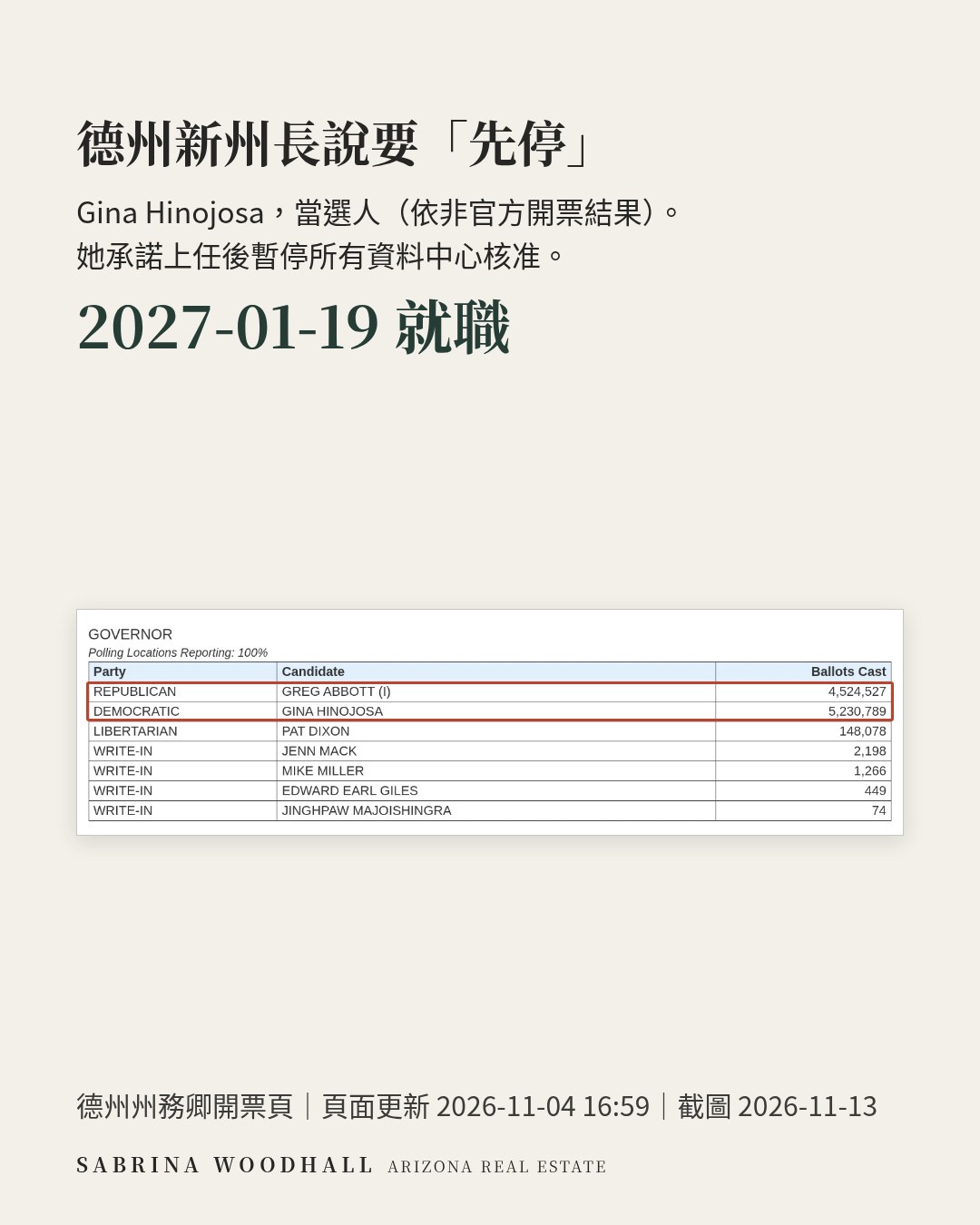
Texas- Election results: Gina Hinojosa (Democrat), governor-elect (based on unofficial results). In the Texas Secretary of State's unofficial count, Hinojosa received 5,230,789 votes and incumbent Gov. Greg Abbott received 4,524,527. She takes office on 2027-01-19. (Texas SOS unofficial results; Texas Tribune 2026-11-04 | checked 2026-11-11)
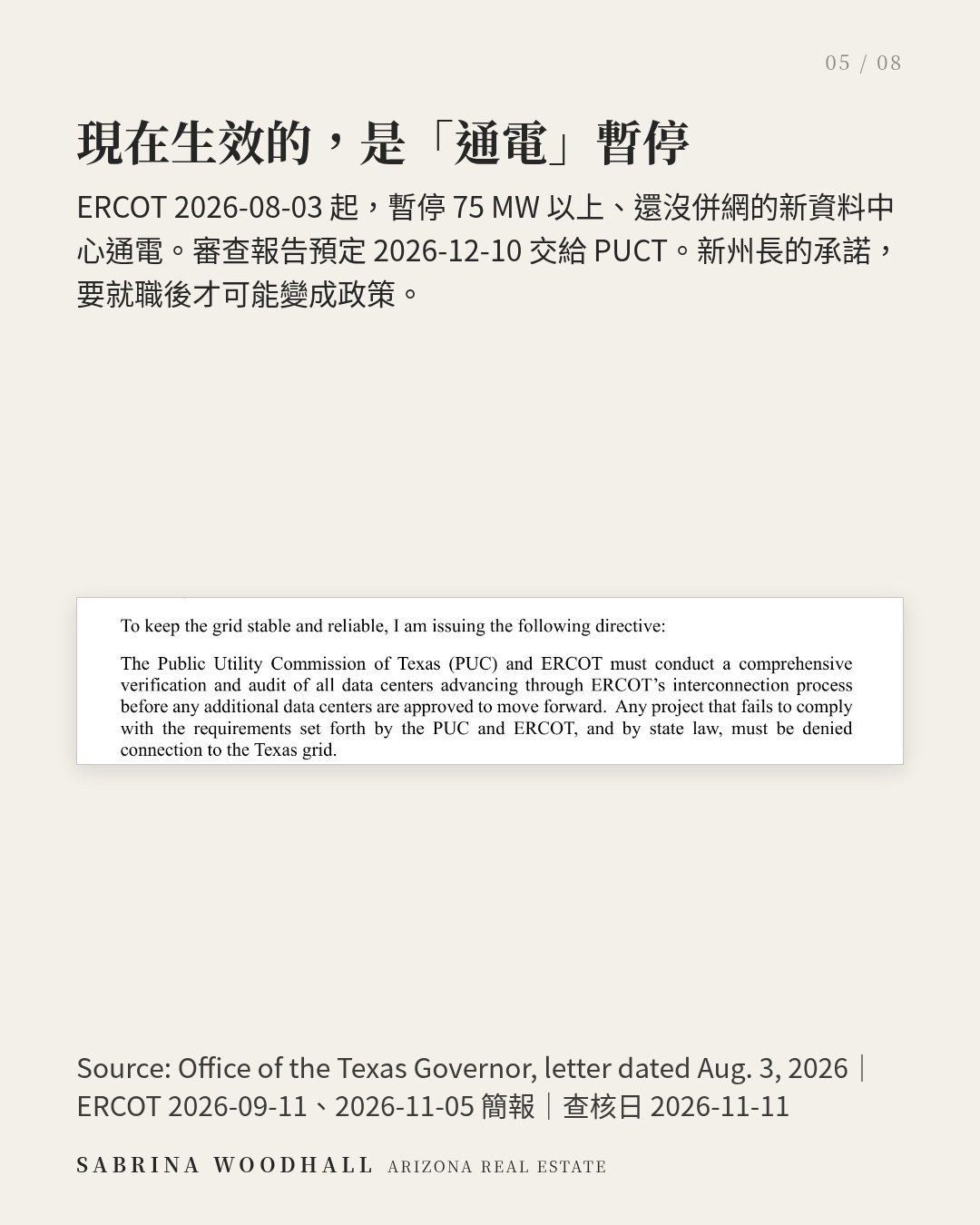
- Measures in effect: Following Gov. Abbott's directive of 2026-08-03, ERCOT has, as of that same day, paused energizing new data centers of 75 MW or more that are not yet connected to the grid (including cryptocurrency mining facilities). What's paused is "energization," not construction. ERCOT's review report is scheduled to be submitted to the Public Utility Commission of Texas (PUCT) on 2026-12-10. (Office of the Texas Governor letter, 2026-08-03; ERCOT Market Notice 2026-08-03, as cited in ERCOT's 2026-09-11 presentation; ERCOT presentation 2026-11-05 | checked 2026-11-11)
- Promised: During the campaign (2026-10-22), Hinojosa said: "When I am governor I will issue a moratorium — a ban — on all data center approvals until laws can be passed by the Legislature to protect Texans". What she wants to pause is data center "approvals"; nothing has been signed yet, and nothing is in effect. (Texas Tribune)
- Post-election remarks: According to media accounts of a CNN interview (2026-11-05), she said: "We have always been a pro-business state in Texas, but what changes now with me as governor is it has to be a partnership that benefits Texans"; in the same interview she also said: "We need to stop what we are doing with data centers until we have those protections". (Mediaite, USA Today)
- Industry side: CoreWeave CEO Michael Intrator wrote to Hinojosa on 2026-11-07. Bloomberg quoted the letter as saying "We strongly support those principles," and reported that he hopes to work with the transition team on the "responsible completion of permitted projects" and "clear, durable standards for future development." This is a company reaching out to seek cooperation, not an agreement between the two sides. (Bloomberg Law)
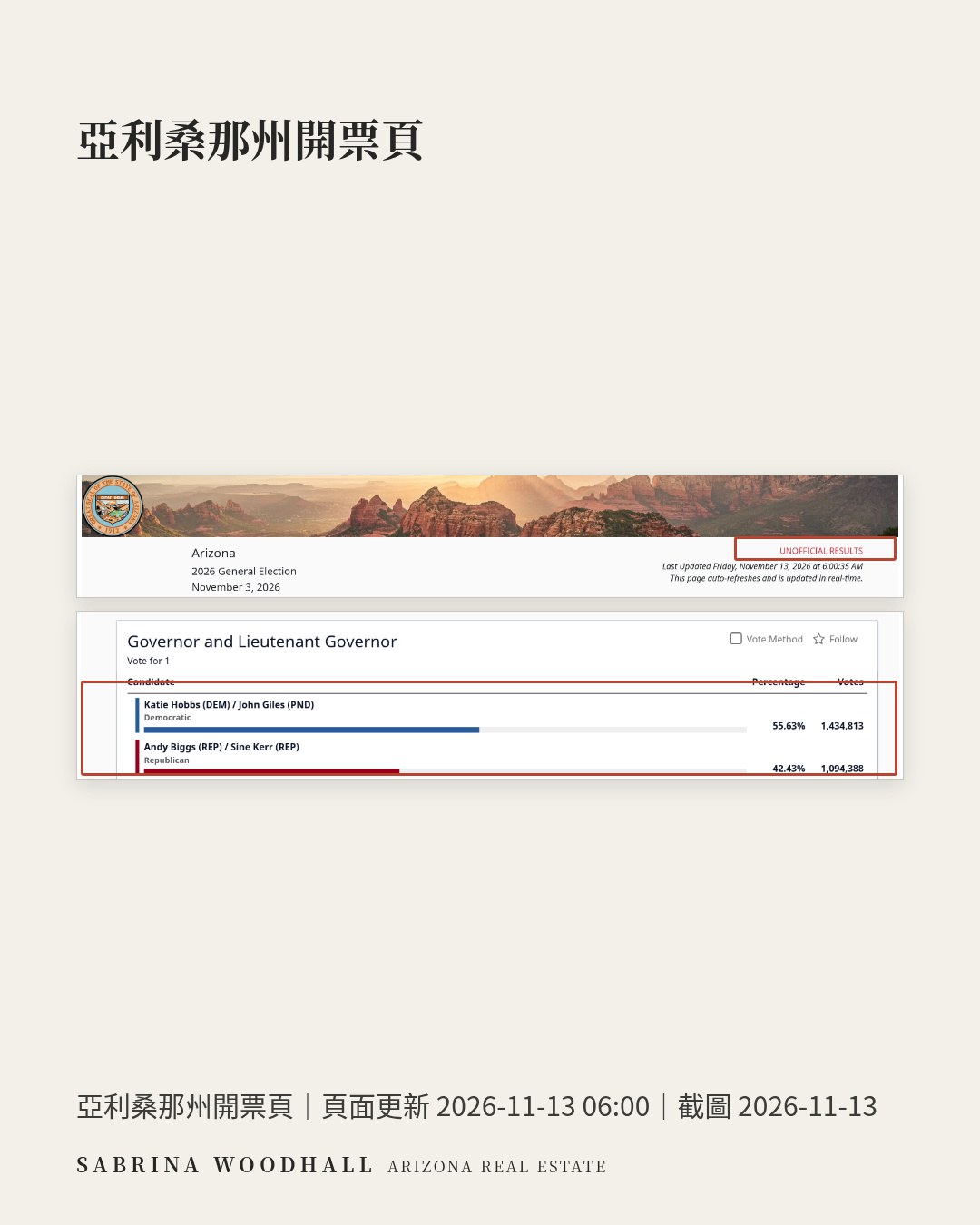
- Election results: Katie Hobbs (Democrat) re-elected (based on unofficial results). In the Secretary of State's unofficial count, Hobbs received 55.63% and Andy Biggs 42.43%. Her second term begins on 2027-01-04. (Arizona Secretary of State unofficial results; Ballotpedia | checked 2026-11-11)
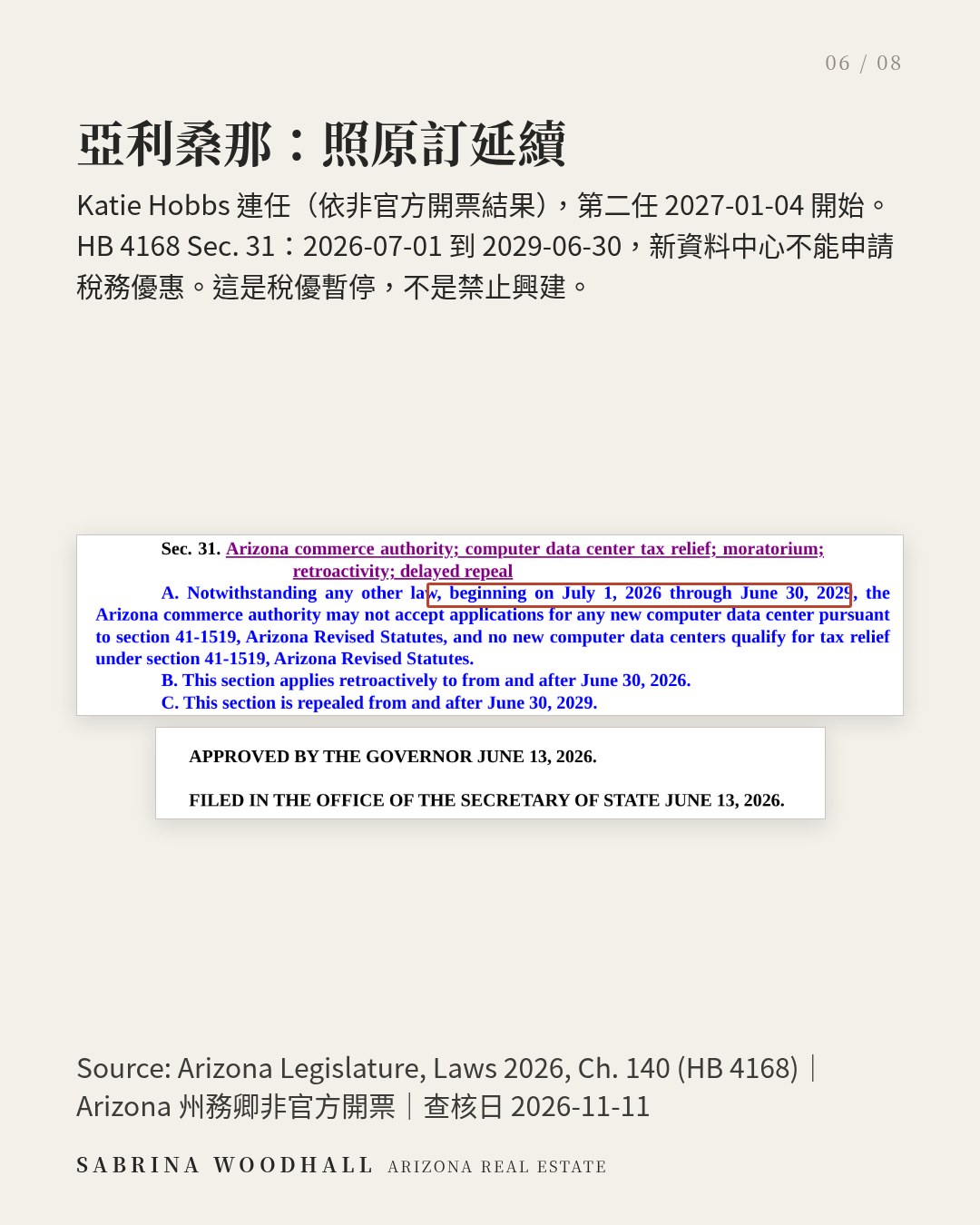
- Measures in effect: HB 4168 Sec. 31. Signed by the governor on 2026-06-13, this law suspends new data center applications for tax incentives from 2026-07-01 through 2029-06-30. What's suspended is the tax incentive—it does not ban construction, and it does not revoke certifications already granted. With Hobbs re-elected, this period continues as originally scheduled. (Arizona Legislature, Laws 2026, Ch. 140 | checked 2026-11-11)
- Under discussion: Some Democratic lawmakers in the state Legislature have made a statewide moratorium a priority, and Attorney General Kris Mayes supports it as well. In September 2026, Gov. Hobbs said a moratorium is not the right approach: "We have to continue to focus on ways that we can grow the economy and do that sustainably". The report says it is unclear whether her position has changed since the election; whether any new rules will follow is not yet known. (Arizona Capitol Times 2026-11-10)
- Post-election remarks: At a re-election rally on 2026-11-06, Hobbs said: "We'll continue protecting our water from the upper basin states, from the federal government, and from out-of-state corporations who want to take it for their own gain". (AZPM 2026-11-09)
Governors elected or re-elected in several other states have also set clear directions on data centers. They're listed here for reference:
| State | Governor and status | Direction | In effect or promised |
|---|---|---|---|
| Ohio | Amy Acton (Democrat), governor-elect (based on unofficial results), takes office 2027-01-11 | Conditional pause: data centers pay 100% of their utility costs, build on brownfield or industrial sites, etc. | Promised |
| Georgia | Keisha Lance Bottoms (Democrat), governor-elect (based on unofficial results), takes office January 2027 | Said in a post-election interview she will sign an executive order pausing new construction, possibly for one to six months or longer | Planned after taking office |
| Pennsylvania | Josh Shapiro (Democrat) re-elected (called by AP, unofficial) | Signed Executive Order 2026-05 on 2026-08-18: data centers pay their own power infrastructure costs, obtain local approval first, nondisclosure agreements prohibited, etc. | In effect |
| Tennessee | Marsha Blackburn (Republican), governor-elect (based on unofficial results), takes office January 2027 | Local communities decide whether they want data centers; supports legislation to protect utility bills, with costs borne by data centers | Promised |
(Sources: Acton campaign website, Ohio SOS/Newsweek; Courier Georgia, GPB, Georgia SOS; pa.gov, S&P Global; WSMV | checked 2026-11-11)
Side-by-Side Overview
| Category | Texas | Arizona |
|---|---|---|
| Price index RPP 2024 (state average / main metro area) | 97.1 / Dallas–Fort Worth 103.1 | 100.7 / Phoenix-Mesa-Chandler 103.3 |
| Residential electricity rate (EIA preliminary August 2026, state average) | 15.91 ¢/kWh | 15.05 ¢/kWh |
| Semiconductor CHIPS direct funding (final awards) | Samsung (Taylor) $4.745 billion; Texas Instruments (Sherman) $900 million | TSMC Arizona (Phoenix) $6.6 billion; Amkor (Peoria) up to $407 million |
| Data center tax incentives | Temporary exemption from the 6.25% state sales/use tax; local sales taxes still apply | State, county and local sales taxes all exempt; new applications suspended 2026-07-01 through 2029-06-30 |
| Data center measures in effect | ERCOT pause on energizing new data centers of 75 MW or more, since 2026-08-03 | HB 4168 Sec. 31 suspension of new tax incentive applications |
| Promised or under discussion | Governor-elect has promised to pause data center approvals; not yet in effect | Legislature discussing a statewide moratorium; outcome undecided |
| Governor's term | Hinojosa takes office 2027-01-19 | Hobbs begins second term 2027-01-04 |
Upcoming dates:
- 2026-12-10: ERCOT review report scheduled to be submitted to PUCT
- 2027-01-04: Hobbs begins her second term
- 2027-01-11: Acton takes office (Ohio)
- 2027-01-19: Hinojosa takes office (Texas)
There is currently no official evidence that the election results will shift data centers or demand between the two states, and these policies can't be used to draw conclusions about home prices.
Questions to Help You Choose
- Which expense takes up the largest share of your day-to-day spending? Compare it against the price index and residential electricity rates above.
- What industry do you work in? Are the semiconductor funding and data center policies listed above relevant to your industry?
- Which metro area would you live in, and how far would you commute? State averages and metro-area numbers differ.
- If you use a lot of electricity in summer, how much of your monthly spending goes to the power bill? Residential rates are state averages; your actual bill depends on your utility and how you use electricity.
If you'd like to factor ownership costs like electricity and taxes into your home-buying budget, see our home-buying costs guide; for what to look for when choosing a neighborhood, see our neighborhood checklist.
If you'd like to talk through your own situation, leave your question on the contact page.
All election results are unofficial and may change before certification. This article compiles public information and does not constitute investment advice or individual home-buying advice; for policy updates, please refer to the latest announcements from each state's government and regulatory agencies. Checked 2026-11-11 (CHIPS funding: 2026-11-13).
Sabrina Woodhall|West USA Realty
FAQ
Q1: How different are prices in Texas and Phoenix? BEA RPP 2024 (U.S. = 100): Texas state average 97.1, Dallas–Fort Worth metro area 103.1; Arizona state average 100.7, Phoenix-Mesa-Chandler metro area 103.3. RPP is an index of price levels, not a dollar amount for the cost of living.
Q2: Has Texas's new governor already ordered a pause on data centers? Not yet. Hinojosa is the governor-elect (based on unofficial results) and does not take office until 2027-01-19. She has promised to pause all data center approvals, but nothing has been signed and nothing is in effect. What is in effect now is ERCOT's pause on energization since 2026-08-03 (for new data centers of 75 MW or more that are not yet connected to the grid).
Q3: Has Arizona banned building data centers? No. HB 4168 Sec. 31 suspends new data center applications for tax incentives from 2026-07-01 through 2029-06-30. It does not ban construction, and it does not revoke certifications already granted. The Legislature is separately discussing a statewide moratorium; the outcome is not yet known.
Q4: Will these policies affect home prices in either place? There is currently no official evidence to support that conclusion. This article only lays out public data, measures in effect and upcoming dates for the two places side by side.
Sources
All sources checked 2026-11-11 unless otherwise noted.
- U.S. Department of Commerce 2024-12-20 (Samsung CHIPS final award): https://www.commerce.gov/news/press-releases/2024/12/biden-harris-administration-announces-chips-incentives-award-samsung ; NIST: https://www.nist.gov/chips/samsung-electronics-texas-taylor | checked 2026-11-13
- U.S. Department of Commerce 2024-12-20 (Texas Instruments CHIPS final award): https://www.commerce.gov/news/press-releases/2024/12/biden-harris-administration-announces-chips-incentives-award-texas ; NIST (Sherman portion): https://www.nist.gov/chips/texas-instruments-texas-sherman | checked 2026-11-13
- U.S. Department of Commerce 2024-11-15 (TSMC Arizona CHIPS final award): https://www.commerce.gov/news/press-releases/2024/11/biden-harris-administration-announces-chips-incentives-award-tsmc ; NIST: https://www.nist.gov/chips/tsmc-arizona-phoenix | checked 2026-11-13
- U.S. Department of Commerce 2024-12-20 (Amkor CHIPS final award): https://www.commerce.gov/news/press-releases/2024/12/biden-harris-administration-announces-chips-incentives-award-amkor ; NIST: https://www.nist.gov/chips/amkor-technology-inc-arizona-peoria | checked 2026-11-13
- Texas SOS unofficial results (2026-11-03 election): https://electionresults.sos.state.tx.us/results.html
- Texas Tribune 2026-11-04 (Hinojosa's pledge, inauguration date): https://www.texastribune.org/2026/11/04/data-center-texas-pause-gina-hinojosa-governor-policies/
- Mediaite (quoting CNN interview, 2026-11-05): https://www.mediaite.com/media/tv/jake-tapper-asks-texas-gov-elect-about-elon-musk-and-ais-future-in-her-state-amid-stock-market-rout/
- USA Today 2026-11-05: https://www.usatoday.com/story/news/nation/2026/11/05/texas-is-done-with-data-centers-until-further-notice-new-governor-says/92634485007/
- Bloomberg Law (CoreWeave letter, 2026-11-07): https://news.bloomberglaw.com/artificial-intelligence/coreweave-asks-texas-governor-elect-for-data-center-cooperation
- ERCOT Market Notice 2026-08-03 (suspension of the Batch Zero study process; pause on energizing data centers and cryptocurrency mining facilities of 75 MW or more; data date 2026-08-03, original text quoted in ERCOT's 2026-09-11 Batch Zero presentation, "Actions taken by ERCOT"): https://www.ercot.com/files/docs/2026/09/11/14-Batch-Zero-Update.pdf | checked 2026-11-11
- Office of the Texas Governor letter to the PUCT Chairman and ERCOT CEO (data date 2026-08-03): https://gov.texas.gov/uploads/files/press/Thomas_Gleeson_Pablo_Vegas_Data_Centers_Directive_Letter_to_PUCT_ERCOT_August_2026_.pdf | checked 2026-11-11
- ERCOT 2026-11-05 Verification RFI presentation: https://www.ercot.com/files/docs/2026/11/05/ERCOT-Verification-RFI-Update.pdf
- Arizona Secretary of State unofficial results: https://app.enhancedvoting.com/results/public/Arizona/elections/110326GeneralElection?cg=State
- Ballotpedia (start date of Hobbs's second term): https://ballotpedia.org/Governor_of_Arizona
- Arizona Legislature, Laws 2026, Ch. 140 (HB 4168): https://www.azleg.gov/legtext/57leg/2R/laws/0140.htm
- Arizona Capitol Times 2026-11-10: https://azcapitoltimes.com/news/2026/11/10/data-center-regulation-could-be-first-test-of-arizonas-new-democratic-trifecta/
- AZPM 2026-11-09 (Hobbs's rally remarks): https://www.azpm.org/elections/2026-11-09/arizona-has-had-the-final-word-gov-hobbs-celebrates-reelection-in-tucson
- EIA Electric Power Monthly Table 5.6.A (preliminary August 2026 data): https://www.eia.gov/electricity/monthly/epm_table_grapher.php?t=epmt_5_6_a
- BEA RPP 2024 (states): https://apps.bea.gov/regional/zip/SARPP.zip ; (metro areas): https://apps.bea.gov/regional/zip/MARPP.zip
- Texas Comptroller (data center taxes): https://comptroller.texas.gov/taxes/data-centers/
- Arizona Commerce Authority (Computer Data Center Program): https://www.azcommerce.com/incentives/computer-data-center-program/
- Ohio SOS: https://liveresults.ohiosos.gov/ ; Newsweek: https://www.newsweek.com/ohio-governor-acton-ramaswamy-election-winner-2026-12659106
- Acton campaign website: https://actonforgovernor.com/issue/data-centers/
- Georgia SOS: https://results.sos.ga.gov/results/public/georgia/elections/11032026GeneralAndSpecialElection
- Courier Georgia: https://couriergeorgia.com/news/bottoms-medicaid-data-centers/ ; GPB 2026-11-09: https://www.gpb.org/news/2026/11/09/in-georgia-data-centers-may-be-getting-new-outlook
- pa.gov EO 2026-05: https://www.pa.gov/governor/newsroom/2026-press-releases/governor-shapiro-signs-executive-order-on-data-center-developmen
- S&P Global (Shapiro re-election): https://www.spglobal.com/energy/en/news-research/latest-news/electric-power/110426-democrat-josh-shapiro-wins-reelection-for-governor-in-pennsylvania
- WSMV 2026-11-04 (Blackburn elected): https://www.wsmv.com/2026/11/04/marsha-blackburn-becomes-first-woman-elected-tennessee-governors-office-per-secretary-state/ ; WSMV 2026-10-26 (candidates' data center positions): https://www.wsmv.com/2026/10/26/tn-candidates-governor-explain-how-theyd-handle-data-centers-if-elected/
Cover photos: Andrew nyr (Equinix DA11, Dallas), Hunter Trick (TSMC Fab 21, Phoenix), Wikimedia Commons, CC BY-SA 4.0 https://creativecommons.org/licenses/by-sa/4.0/